Gyaan Shrinkhala Course - 3 on “Disaster as Social Political Processes”
- Rachana UpadhyayaDetails
 Gyaan Shrinkhala Short courses on Governanace Course 3
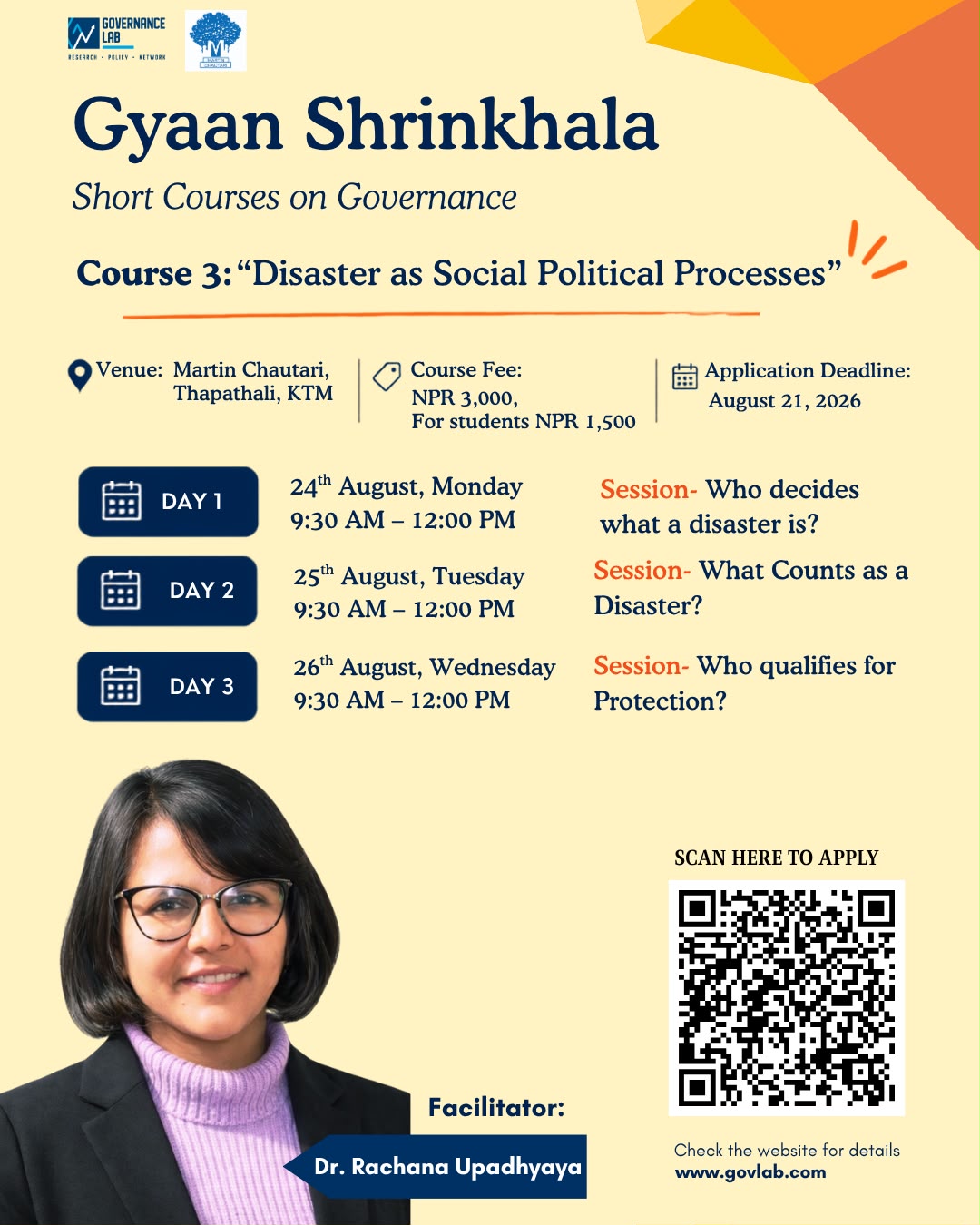
Gyaan Shrinkhala- Short Courses on Governance
A joint initiative of Martin Chautari & Governance Lab
Gyaan Shrinkhala Course - 3
On
“Disaster as Social Political Processes”
Date: August 24, 25 & 26, 2026 (Monday, Tuesday, Wednesday)
Time: 9:30 AM – 12:00 PM
Venue: Martin Chautari, Thapathali, Kathmandu
Course Fee: NPR 3,000/-; For students NPR 1,500/-
Application Deadline: August 21, 2026
Apply Now: https://forms.gle/SiTDytcJSNPeYvVs6
Course Overview
For its third edition, Gyaan Shrinkhala is taking a workshop-based approach, creating a more interactive and participatory learning space around the theme Join us for a three-day interactive workshop on:
“Disaster as social political processes”
It will focus on Disasters as Socio-Political Processes. The workshop is designed as a journey of inquiry into disaster risk reduction and management in Nepal, structured around three questions:
- Who decides what a disaster is?
- What counts as a disaster?
- And who qualifies for protection?
Rather than treating disasters as simply natural events, the workshop explores how disasters are defined, governed, and experienced through the lenses of power and justice. The three-day workshop moves progressively from understanding how power is exercised, to examining how disasters are defined, and finally to questioning how justice and protection are distributed.
The workshop is designed to challenge conventional, reductive understandings of disasters and to develop a critical perspective on disaster governance in Nepal.
The three-day workshop will be facilitated by Dr. Rachana Upadhyaya.
Participants will be provided with relevant reference reading materials prior to the workshop. The sessions will be conducted through a combination of interactive activities, discussion, case studies, participatory exercises, and short lectures.
A brief description of each session is provided below:
Day 1 (24th August, Monday, 9:30 AM – 12:00 PM)
Who decides what a Disaster is?
Theme: Institutions, Authority, and Governance
Guiding Questions
- When does an event become a disaster? (Case of floods in Kathmandu)
- What roles do local/provincial/federal governments, NGOs, media and scientists play?
- Who gets excluded in the process?
This session will explore the institutions, laws, and governance systems that shape disaster decision-making in Nepal, including who has the authority to respond and allocate resources. Using the case of floods in Kathmandu, the session will examine the roles of different institutions and actors involved in disaster governance.
Day 2 (25th August, Tuesday, 9:30 AM – 12:00 PM)
What Counts as a Disaster?
Theme: Histories, Politics and Changing Ideas
Guiding Questions
- Why do some events become disasters while others remain invisible?
- Why do floods receive attention while air pollution, unsafe housing or displacement often do not?
- Why are some remembered, and others forgotten?
This session will examine why some events become recognised as disasters while others remain invisible. Participants will explore how historical processes, development agendas, scientific knowledge, collective memory, and formal policy definitions shape how disasters are understood.
Day 3 (26th August, Wednesday, 9:30 AM – 12:00 PM)
Who qualifies for Protection?
Theme: Citizenship, inequality and vulnerability
Guiding Questions:
- Whom does disaster governance serve?
- Whose losses are recognised?
- Who gets compensated
- Who gets ignored (link to floods in the valley)
The final session will examine whose losses are recognised, who receives protection and compensation, and who may be overlooked. Participants will explore how social, economic, political, and environmental inequalities shape vulnerability and experiences of disaster.
Facilitator: Dr. Rachana Upadhyaya
Dr. Rachana Upadhyaya is a researcher and practitioner with more than 18 years of experience working in Nepal at the interface of theory, research and practice. She holds a PhD in Disaster Sociology from the University of Bristol, UK, and is affiliated with the University of Bristol. Her work focuses on understanding disaster not simply as a physical or natural event, but as a socio-political process shaped by power, institutions and social relations. Her research particularly examines marginality and differential vulnerability, and how these shape people’s experiences of risk, disaster and recovery. Through her work, she brings together theoretical perspectives and grounded insights from Nepal to critically examine who is exposed to risk, whose vulnerabilities are recognised, and whose lives and interests are prioritised in disaster governance.